×


| Primary Category | Secondary Item | Detailed Specification Description |
|---|---|---|
| 1. Basic Product Information | Full Product Name | Color Recognition Mini Palace Lantern Course Package (RGB Color Recognition Maker Programming Kit) |
| Manufacturer | BIT-TREE CREATIVITY (Integrated Supplier of STEM Teaching Kits and Courses) | |
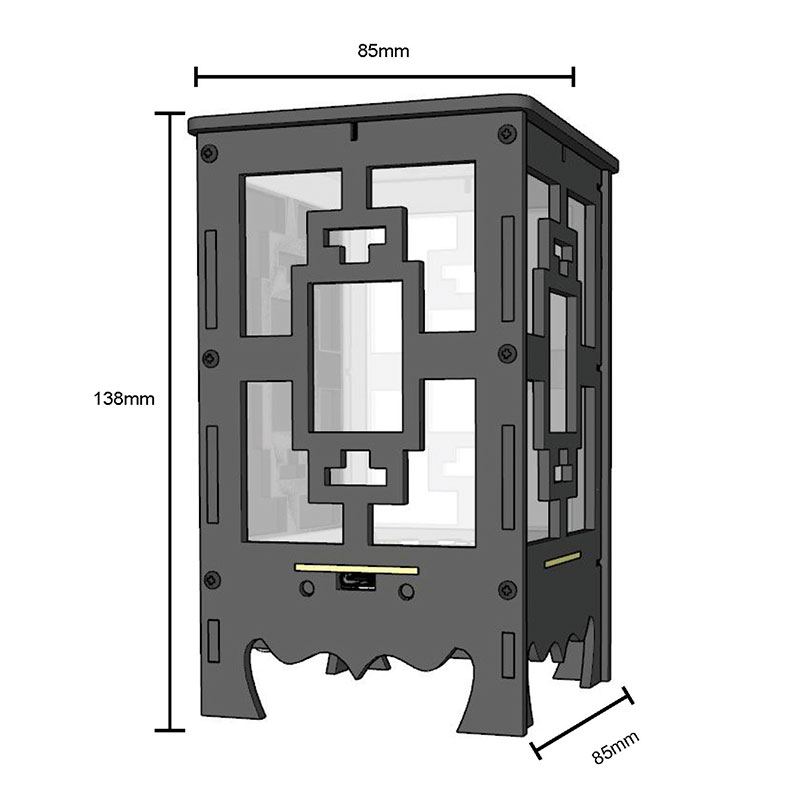
| Overall Dimensions | 138mm×85mm×85mm | |
| Housing Material | Acrylic sheet, modular snap-fit palace lantern housing (6 panels: front, rear, left, right, top, bottom) | |
| Product Positioning | Interdisciplinary STEAM teaching kit combining color optics and programming. Suitable for maker classes, after-school clubs and science experiment lessons in primary and secondary schools. | |
| Power Supply Parameters | Standard external power: DC5V/1A via Type-C port; Built-in backup: KM603.140 lithium battery, 3.7V 600mAh, supports offline operation | |
| 2. Hardware & Electrical Configuration | Main Control Chip | LGT328P MCU, 32MHz main frequency. Hardware compatible with Arduino UNO core and BIT.U1 development standard |
| Core Sensor Module | Color recognition sensor (RGB color sensing module, equivalent to TCS34725), collects R/G/B primary color values of objects | |
| Lighting Module | Full-color RGB LED module, adjusts light colors in real time based on color data captured by the sensor | |
| Interactive Accessories | Physical function keys for mode switching and light control; reserved IO expansion pins | |
| Hardware Interface | Type-C (2-in-1 for power supply and program downloading) | |
| Accessory List | Acrylic six-side panels, main control board, color recognition sensor, 3.7V lithium battery, USB cable, screwdriver, screw & nut kit | |
| 3. Product Functional Parameters | Core Color Recognition Function | The sensor captures tricolor data of objects at close range. The program converts RGB values and drives the built-in RGB light to synchronously display colors, achieving bionic color-changing effect (chameleon color rendering) |
| Programmable Extended Functions | 1. Night Light Mode: Program to realize constant warm light and timed light-off; 2. Colorful Running Light: Circulating gradient RGB lighting; 3. Custom Light Effects: Breathing light, segmented color change and other lighting gameplay | |
| Mode Switching | Switch between native color recognition mode and custom light mode via key operation | |
| 4. Programming Development Parameters | Supported Programming Languages | Graphical block programming, C, C++ |
| Compatible Programming Software | Arduino IDE, Mixly Block Programming (Universal development environment for all brand products) | |
| Programming & Academic Knowledge Points | 1. Optics: Three-primary-color mixing principle, object reflective color theory; 2. Hardware Programming: AD data reading of color sensor, RGB-PWM dimming control, key IO detection; 3. Program Logic: Variable mapping, conditional judgment, cyclic gradient algorithm | |
| Assembly & Programming Difficulty | Low hardware assembly difficulty with modular snap structure. Students with zero foundation can complete assembly independently. The supporting sample programs feature simple logic and are easy to get started | |
| 5. Supporting Courses & Experiments | Supporting Experimental Projects | Three core experiments: ①Basic RGB Light Experiment; ②Color Recognition & Acquisition Experiment; ③Key-controlled Light Switching Experiment |
| Ability Cultivation | Color optics cognition, sensor application, PWM dimming principle, hardware wiring & assembly, creative light programming design | |
| Application Scenarios | Children’s color enlightenment, information technology programming courses, DIY exhibits for school science festivals, entry-level STEM training |