×


| Level 1 Category | Level 2 Item | Parameter Description |
|---|---|---|
| I. Basic Product Information | Full Product Name | Laser Harp Course Package (Stringless, Beam-sensing Programmable Music Maker Kit) |
| Manufacturer | BIT-TREE CREATIVITY (Integrated Supplier of Science Education Kits & Courses) | |
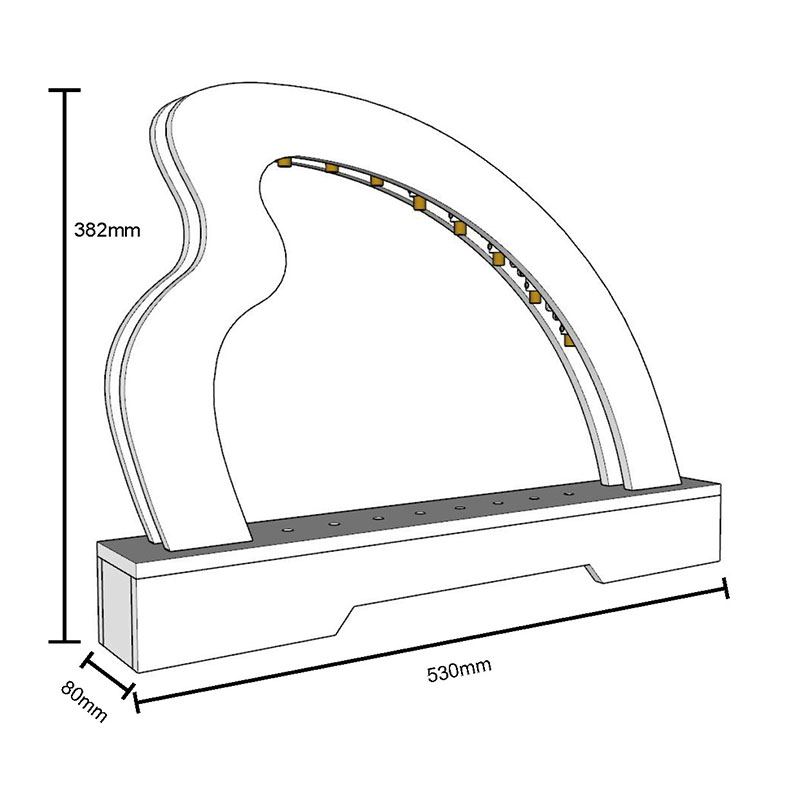
| Overall Dimensions | L 530mm × W 382mm × H 80mm | |
| Product Positioning | STEAM interdisciplinary teaching kit (Optics + Music Theory + Programming). Suitable for maker classrooms, tech clubs and innovation competitions in primary & secondary schools. Unified mainboard system within the brand series. | |
| Power Supply Specification | Standard DC5V power supply. Supports three power modes: USB cable, 5V power adapter, power bank. | |
| Main Structure | Assembled acrylic & wooden bracket, upper-lower split structure. Laser transmitter modules installed on the top; corresponding photosensitive receiver modules at the bottom. | |
| II. Hardware Configuration Parameters | Laser Sound Strings | Standard 8 independent laser transmitter modules forming 8 virtual laser strings. One laser beam corresponds to one fixed musical note. |
| Sensing Acquisition Module | 8-channel photosensitive sensors (photoresistor / photoelectric receiver), one-to-one matched with each laser path. Beam blocking triggers signal variation. | |
| Audio Module | Built-in amplified speaker module. The mainboard outputs square waves of different frequencies to generate corresponding note sounds; supports external speaker expansion. | |
| Mainboard Compatibility | Compatible with BIT.U1 (ATmega328P, Arduino architecture) and BIT.S3 (ESP32) official boards. Shares hardware & programming system with password lock, smart trash can, traffic light and triangle piano kits. | |
| Reserved Expansion Pins | Spare IO pins reserved for external functional buttons and LED indicators; supports extended functions including melody switching and tone selection. | |
| III. Product Function Parameters | Manual Playing Mode | Block a single laser beam → photosensitive receiver loses light → mainboard detects signal → speaker outputs corresponding note. 8 beams correspond to 8 basic notes for impromptu performance. |
| Auto Playback Function | Modify built-in music coding to realize unattended cyclic playback of preset complete tracks. | |
| Expandable Programmable Functions | Customize pitch of 8 notes, switch multiple instrument tones, add beat indicator lighting and segmented loop playback. | |
| Subject Feature | No physical strings. Sound is generated via light blocking principle for intuitive learning of photosensitive sensing theory. | |
| IV. Assembly & Programming Parameters | Assembly Difficulty | Relatively high hardware assembly difficulty. Precise alignment of upper & lower laser and sensor positions is required. Cultivate spatial assembly and circuit wiring skills; step-by-step assembly drawings included. |
| Programming Difficulty | Low coding difficulty, beginner-friendly sample codes. | |
| Development Environment |
1. Graphical Programming: Mixly block coding
|
|
| Programming Knowledge Points |
1. Science: Optical principles, photoelectric characteristics of photosensitive components
|
|
| V. Courses & Supporting Resources | Training Objectives | Optics popular science, music theory learning, circuit wiring/soldering, embedded programming, music programming creation, spatial structure building ability |
| Supporting Materials | Official assembly manual, circuit schematic, two sets of sample source codes (manual playing base program + auto-play program) and teaching plans | |
| Application Scenarios | Optical experiments for science classes, integrated programming & music teaching, campus tech exhibition, student STEM DIY projects |